
Why reading matters
Readers become what they read
Opinion piece by ACT member, Savvas Costi
These are silly times
“That’s Mike Teavee! He’s the television fiend!” A striking introduction as the big day arrives and Mike is one of five fortunate children with a golden ticket, securing a rare opportunity to explore Mr Wonka’s wonderous chocolate factory.[1] Of course, Roald Dahl is keen to offer teaching points through all the child characters in his story, and it is with Mike Teavee in particular that his obsession with the television is what brings about his demise. In chapter twenty-seven, where Mike Teavee ends up being shrunk by the television, the Oompa-Loompas sing,
‘The most important thing we’ve learned,
So far as children are concerned,
Is never, NEVER, NEVER let
Them near your television set –
Or better still, just don’t install
The idiotic thing at all.’
What’s the big deal with children and television? Is there a particular point Dahl is trying to make here? The song continues,
‘To wonder just exactly what
This does to your beloved tot?
IT ROTS THE SENSES IN THE HEAD!
IT KILLS IMAGINATION DEAD! …
HIS BRAIN BECOMES AS SOFT AS CHEESE!
HIS POWERS OF THINKING RUST AND FREEZE!
HE CANNOT THINK – HE ONLY SEES!’
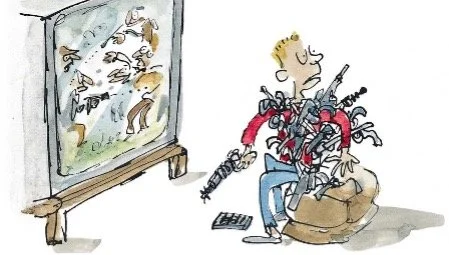
Point taken Mr Dahl. Much like how screens today are used to pacify unruly kids. Not much has changed since the book first released in 1964! The song’s not finished though, there is more;
‘“What used the darling ones to do?
How used they keep themselves contented
Before this monster was invented?”
Have you forgotten? Don’t you know?’
Remarkable given this was written years before the arrival of smartphones and tablets,
‘THEY … USED … TO … READ! They’d READ and READ,
AND READ and READ, and then proceed
TO READ some more. Great Scott! Gadzooks!
One half their lives was reading books!’[1]
Well clearly Roald Dahl was invested in reading given children’s books were a big part of his livelihood, but is it really that damaging for those wishing to indulge in screens instead of books? We’ve now amassed enough data to draw some conclusions, and Neil O’Brien after a closer look at the numbers has concluded, ‘the shift from reading to video clips is rotting our brain.’ It’s an important essay with a stark ending worth repeating here; ‘that there is enough evidence already to worry that young people are losing crucial skills, and suffering cognitively because of the decline of reading.’[2] A sad narrative that’s been ongoing since Roald Dahl wrote his book back in the 60s, except now things are a lot worse given how ubiquitous technology has become.
And it wasn’t just recently that the alarm was raised around unhealthy tech habits. In 2018, Maryanne Wolf, citing the work of psychologist Patricia Greenfield, had this to say;
‘The more exposure to (time spent with) any medium, the more the characteristics of the medium (affordances) will influence the characteristics of the viewer (learner). The medium is the messenger to the cortex, and it begins to shape it from the very start … In our enthusiasm to be early adapters [of devices] … are we putting our children in harm’s way?’[3]
Looks like we did as the phone-based childhood led to what Jonathan Haidt called ‘the Great Rewiring’ for a whole generation of kids.[4] Freya India who lived through this documents her experiences in her book GIRLS®,[5] with numerous cringe-worthy and jaw-dropping moments of what young people were doing to themselves online. Much of it was irrational as it was designed to be for impressionable teenagers. When tech rules, particularly social media,[6]screens dull cognition as our ‘powers of thinking rust and freeze.’
It was the cultural critic Marshall McLuhan who famously declared that “the medium is the message.” By this he meant that technology is not simply a tool to deliver goods, but ‘a means of reshaping society.’[7] And it looks like this is exactly what happened. Writers elsewhere were commenting about reading struggles for themselves and their students. In 2011, the English professor, Alan Jacobs was aware that younger cohorts were hearing they were, “The Dumbest Generation,” a tragic and unhelpful label. They were ‘continually told that their addiction to multiple simultaneous stimuli renders them incapable of the seriously focused and single-minded attention that the reading of big thick books requires.’[8] Not exactly what you need to hear if you’ve paid lots of money to go read at a university, although it’s clear to see how more distracting everything became once we went from the clunky televisions and desktops rooted in living rooms, to portable laptops and tablets that fit in your bags. Why read when endless entertainment is available in the keep-it-in-your-pockets-so-it’s-always-with-you smartphones?
And it got worse, the Covid pandemic accelerated the move towards more digital forms of working across different industries, including education, where students were obligated to keep using their phones when not enough was done to mitigate the distractions that came with it. Students were not the only ones affected. Jacobs also comments on how ‘people up to forty and in a few cases older’ were also having reading struggles. It was Nicholas Carr who wrote a book about how the internet was changing the way we think, read and remember,[9] whose words are sobering and warrant careful reflection;
‘Over the past few years I’ve had an uncomfortable sense that someone, or something, has been tinkering with my brain, remapping the neural circuitry, reprogramming the memory. … I’m not thinking the way I used to. I can feel it most strongly when I’m reading. Immersing myself in a book or a lengthy article used to be easy. My mind would get caught up in the narrative or the turns of the argument, and I’d spend hours strolling through long stretches of prose. That’s rarely the case anymore. Now my concentration often starts to drift after two or three pages. I get fidgety, lose the thread, begin looking for something else to do. I feel as if I’m always dragging my wayward brain back to the text. The deep reading that used to come naturally has become a struggle.’[10]
What happens if no one reads anymore or if we can’t even consult those who are well read? Not surprisingly, we end up with the death of expertise, confusion and the continued erosion of truth. It’s the space where reality begins to bite in ways that hurt. Suffering increases in these hard times as we end up with people in key positions of influence and power, who ‘spin like tops in the current moment, unable to draw from the past and speak into the future. Without … prophetic imagination, these artists of the moment cannot make anything worth lasting.’[11] Fleeting fads abound when what is needed is a legacy that lasts, and books serve as the Great Preservers for passing on what should never be forgotten, so long as we retain those who can keep reading.
That’s not to say deep reading can’t be relearned, but retraining will require nurturing some overlooked virtues that I’ll say more about later (reading this whole essay is a great place to start!) Just as cigarettes were once mainstream and had to be rolled back, I see parallels emerging with our use of technology. For example, some countries have begun issuing bans around phones in schools, including England where I live, and for good reason! There is a growing body of research suggesting our use of technology in education has been unwise. As a teacher myself, I’ve long suspected that print based learning was more effective, and that students should take notes by hand instead of typing. Too many school leaders fell for The Digital Delusion,[12] and just as Sweden were ahead of the curve during the pandemic, they’re now pioneering what looks like a cut back on digital learning. A good digital tidy up is clearly in order.
That’s not to say I or those referenced in the paragraph above are anti-tech. We’re not. Obviously I am using it to write and share this essay. What I’m advocating for is a return to real learning, and a proper education that helps young people prepare for the real world. I’ve found the work of Cal Newport extremely helpful here. His approach to technology is one where ‘you focus your online time on a small number of carefully selected and optimised activities that strongly support things you value, and then happily miss out on everything else [italics mine].’[13] The problem has been not enough thought went into the things we value, or the trade-offs that came with our use of technology, and a recovery is now urgently needed. A model for how to do this with some helpful diagnostic questions can be found in a recent essay by Andy Bannister.[14] He suggests we ask three questions about our use of technology:
1) What does this technology add: what are the pluses, the bonuses, the wins?
2) What does this technology take away: what are the minuses, the loses, the costs?
3) How does this technology affect our relationships, our community?
We need to move away from what Neil Postman termed, the “Age of Show Business,” where we ‘purvey content’ in a Show-and-Tell manner to broadcast and entertain,[15] and recover the best elements of the “Age of Exposition,” where we can have robust conversations about things that matter, with rigour. Indeed in Postman’s view, ‘a citizenry that reads becomes serious. On a diet of television, a citizenry turns silly.’[16]
Why it matters
Reading matters because it could make you the most persuasive person in the room. It’s not the act of reading itself but the impact of reading upon the individual. To be both well informed and grounded having taken the time and effort (so challenging in today’s hyper-busy contexts) to formulate ideas and arguments, grapple through possible responses, wrestle with texts and expand our imagination to perhaps see what we couldn’t see before. It’s the hard work that requires discipline for the deep digging necessary for reaching those hidden treasures. And in a localised spot, not spreading ourselves thinly trying to know something about everything. A little learning is a dangerous thing after all.[18]Instead what is needed is the focused work required to really know what you’re talking about. There are no quick fixes here, it’s toilsome work but very rewarding and urgently needed. History is replete with examples of people who’ve walked this way before, where the time used for serious thinking and study served as a catalyst for positive change and renewal. Martin Luther comes to mind. Would the Reformation have taken off had he not done the mental hard work of pouring over the Christian Scriptures and clearly thinking through what ailed his society, and what was needed for moving forward? Imagine if Luther had picked up his phone?[19]
As Jeff Mingee notes, ‘phrases like “I beat importunately upon Paul at that place” and “meditating day and night” describe a man who spent hours hunched over his Bible, painstakingly pouring over Paul’s words.’[20] Another way to look at this is through Eugene Peterson’s image of a dog worrying a bone to convey what good reading involves. He says, ‘I always took delight in my dog’s delight, his playful seriousness [italics mine]’ as he chewed over the bone.[21] I love this picture, this ‘dog-with-a-bone’ kind of reading, where pleasure is derived from chewing over the words on a page in unhurried delight. A reader who, in the words of Rainer Maria Rilke, ‘does not always remain bent over his pages; he often leans back and closes his eyes over a line he has been reading again, and its meaning spreads through his blood.’[22] In the Christian tradition, this is what it means to have ‘the word of Christ dwell in you richly’ (Col. 3:16)[23]or to have God’s word ‘hidden’ or ‘stored up in my heart’ (Psalm 119:11).[24]
And there’s more going on here than mere knowledge transfer. It’s a kind of personal knowledge which comes through encounter, or what Katherine Sonderegger referred to as ‘the dearness of Scripture,’ where ‘we read … in order to enter into the Divine Presence, to walk before Him, to draw near.’[25] Of course, Christians like me believe God speaks through the Bible, but there is also wisdom to be gained from engaging with wider works of great literature. Karen Swallow Prior in her brilliant book, On Reading Well, testifies to the wisdom that can be gained from reading promiscuously (her word for reading widely) as well as reading virtuously (reading well because there is such a thing as bad reading!), all of which aids us to see The Good Life through great books.[26] It’s the kind of reading that’s formativeand changes us over time. It’s another reason why we need more readers in society because ultimately, they show us that readers become what they read. You could be one of them!
A word to my fellow teachers
Given the decline of reading, Neil O’Brien ended his essay with the question, ‘What would you do?’ That question prompted the writing of this essay, and I’m going to end it with some practical suggestions on what could be done to help reverse course and boost literacy. My suggestions are heuristic rather than dogmatic, because I see these as key principles we should all be aiming for, but how they are earthed and embedded in varying contexts might differ, and will be open for the reader to explore what best practise looks like wherever they are. My four suggestions are below:
· School’s should work to embed a reading culture across departments in schools. It should not be left to the English department only. The need has become so great that it has turned into a whole school issue, because if students can’t read, then they will struggle to answer the exam question or complete the assignment, whatever the subject is. Some schools have already taken the step to appoint Literacy Leads, or to appoint one of the Senior Leaders to take charge with pushing this. If any improvements are going to be seen at school level, it’s going to require nothing less than a whole-school push. Could a cross-department ‘steer group’ be created to meet regularly to explore how this could be done within their own school context? Added to this, I’d like to see libraries return to being the main hub of the school, like they used to be. Where we appoint librarians charged with stocking and running the library space, and make this accessible to the whole school community. Of course, the library is meant to be a quiet space, where careful reading and reflection can take place. Some schools chose to shrink their libraries. A U-turn here needs to happen, whether it’s one space only, or across multiple spaces on the school site. Let’s bring back the library!
· Roll back on EdTech and go back to print based learning. There is a gap in the market for an educational device that enables teachers to have full control over what students are doing. There may be one already out there, but from what I’ve seen so far, they’ve not been good enough to mitigate the distractions that come with using devices in class. There is also now a growing body of data, referenced already in this essay, suggesting the move away from print based learning did more harm than good. This is important because others have already arguedthat ‘through its form, print produced a culture of reasonable and disciplined thinking.’ Let’s also have much of that in classroom!
· Encourage parents to read to their children when young and reduce screen time. This tends to be a mixed bag across the student body, dependent on the type of family and background a student has come from. I was pleased to see my daughter’s school writing to us before Christmas discouraging us from buying them a smartphone (my daughter was seven at the time). They also began offering consultation sessions for parents to come into schools to discuss how best to raise kids in the smartphone era. I think more of this would be a great way forward, not only to explore a pressing topic but also to strengthen the relationship between schools and parents who clearly need to work together to tackle this problem. In fact, Andrew Spencer rightly argues that ‘widespread resistance to technological domination can happen only when robust communities with strong social fabrics enable that resistance.’[27] It’ll take collective action to build what Alan Jacobs calls ‘Reading at Whim,’ where we read, ‘not to teach, not to criticise, just for love.’[28] Yes to more of this please.
· No social media for under 18s. I don’t think this is a question of government overreach if it’s become clear how damaging this has been, then I would classify using it as being of the same category as smoking, drinking alcohol, or driving a car. Social media is for grown-ups. And it needs a name change. Why not just call it the Online Sphere?
So there you have it. Those would be my suggestions for trying to address a growing problem. I wonder what Neil O’Brien would make of them? A final plea would be for Churches to help by speaking more into this issue, and taking a strong stance on using printed bibles in gathered meetings, as Ian Paul has helpfully suggested. Here’s to building the Bookish Life, where we can ‘talk to one another about books, often and at length,’ like C. S. Lewis.[29] Where reading becomes a hobby and “the noblest of distractions.” That being said, why not make a visit to your local library?
[1] Roald Dahl, Charlie and the Chocolate Factory (2016), p.52
[1] Ibid, pp. 131-134. The whole song is worth reading in its entirety.
[2] It’s a must-read essay: https://www.neilobrien.co.uk/p/welcome-to-the-post-literate-world?utm_campaign=post&utm_medium=
[3] Maryanne Wolf, Reader, Come Home (2018), p.107 and p.112.
[4] Jonathan Haidt, The Anxious Generation (2024).
[5] Freya India, GIRLS® (2026).
[6] Haidt and Lukianoff shifted focus from screen time generally, to social media and its impact in a series of Afterwards written online here: https://www.fire.org/news/blogs/eternally-radical-idea/coddling-afterword-part-1-gen-zs-mental-health-continues
[7] Samuel D. James gives a more detailed explanation of what McLuhan meant by this in his brilliant book, Digital Liturgies (2023), p.35-36.
[8] Alan Jacobs, The Pleasures of Reading in an Age of Distraction (2011), p.6.
[9] Nicholas Carr, The Shallows (2010).
[10] Nicholas Carr cited in Alan Jacobs, ThePleasures of Reading in an Age of Distraction (2011), p.7.
[11] Written by Jessica Hooten Wilson here: https://substack.com/home/post/p-191868607
[12] Jared Cooney Horvath, The Digital Delusion (2025).
[13] Cal Newport, Digital Minimalism, (2020) p.28.
[14] You can read the full essay from Andy Bannister here: https://www.andybannister.net/p/black-hats-and-black-mirrors-amish-technology
[15] Much like social media!
[16] Neil Postman cited by Jen Pollock Michel, ‘From the Age of Exposition to the Age of Expression’ in Scrolling Ourselves to Death, edited by Brett McCracken and Ivan Mesa (2025), p. 49.
[17] I should add, the reader should not assume that I’m suggesting the alternative political candidates at the time were much better!
[18] Beware superficiality.
[19] Jeff Mingee wrote a great piece about this for The Gospel Coalition here: https://www.thegospelcoalition.org/article/martin-luther-internet/
[20] Ibid.
[21] Eugene Peterson, Eat This Book (2006), p.1.
[22] Rainer Maria Rilke cited in Eugene Peterson, Eat This Book (2006), p. 4.
[23] Colossians 3:16 (ESV) says, ‘let the word of Christ dwell in you richly, teaching and admonishing one another in all wisdom.’
[24] Psalm 119:11 (NIV) reads ‘I have hidden your word in my heart that I might not sin against you.’ ESV translation says, ‘I have stored up your word in my heart.’
[25] Katherine Sonderegger as cited by Graham McFarlane in A Model for Evangelical Theology (2020), p. 93.
[26] Karen Swallow Prior, On Reading Well (2018), pp. 14-15. I highly recommend reading the whole book.
[27] Andrew Spencer, ‘Heed Huxley’s Warning’ in Scrolling Ourselves to Death, edited by Brett McCracken and Ivan Mesa (2025), p. 206.
[28] Alan Jacobs, The Pleasures of Reading in an Age of Distraction (2011), p.15.
[29] C. S. Lewis, The Reading Life, (2019), p. 14.